Freshman year is weird. With its hallowed rituals of too-big-NSOP-friendgroups and fears of eating in the dining halls alone, it's an awkward, ecstatic, exploratory part of young adulthood defined by big questions like who am I? as where the hell even is that building? When you're in it though, with all the freedom of the first year and "accidentally-getting-on-the-express-train-when-you-need-the-local" it entails, every moment can feel extraordinary. Freshman year is a period of new beginnings, of exploration, of trying things out and perhaps really liking them or maybe realizing they aren't for you.
Fashion is the language with which we communicate ourselves to the world. It broadcasts this is me! This is my subculture, my style, my personhood! In a time like freshman year, when your understanding of yourself is so in flux, how you dress becomes the medium through which you negotiate your identity every single day. Perhaps no one is thinking as critically about their fashion as a college freshman. In a new city, a new country, or a new campus, they are taking in New York City and their peers as much as they are giving back to them - a dialectic. It is an experimental, exciting, sometimes slightly uncomfortable, but almost always fun time. So, to put it simply, we're asking what's up with the freshman? What are they wearing and why are they wearing it? We spoke to a handful of new Columbia College students to try and answer these questions and more.
A recurring theme in every single interview was that everyone is looking to upgrade their style. Which, for a lot of the freshmen, means curating outfits that incorporate more layers or focus on silhouette. Gisela Lau, from San Ramon, California, articulated that shift of mindset succinctly when she described the style in her hometown. "At my school, a lot of people would wear a top and a bottom," whereas here in NYC, she's seeing "far more layers" and accessories. For Nigel Harris, who was born and raised right here in Manhattan, he's still observing a style evolution even if he doesn't find himself terribly far from home. "Here, people are a little more elevated. They have a much more unique, and stronger, sense of style." Fernando Sanchez echoed that sentiment, explaining that his fashion aspirations are to "do my style, but better." Better means more elevated, more expansive, more creative. It means layers and textiles and accessories, while still staying true to the core of his identity.
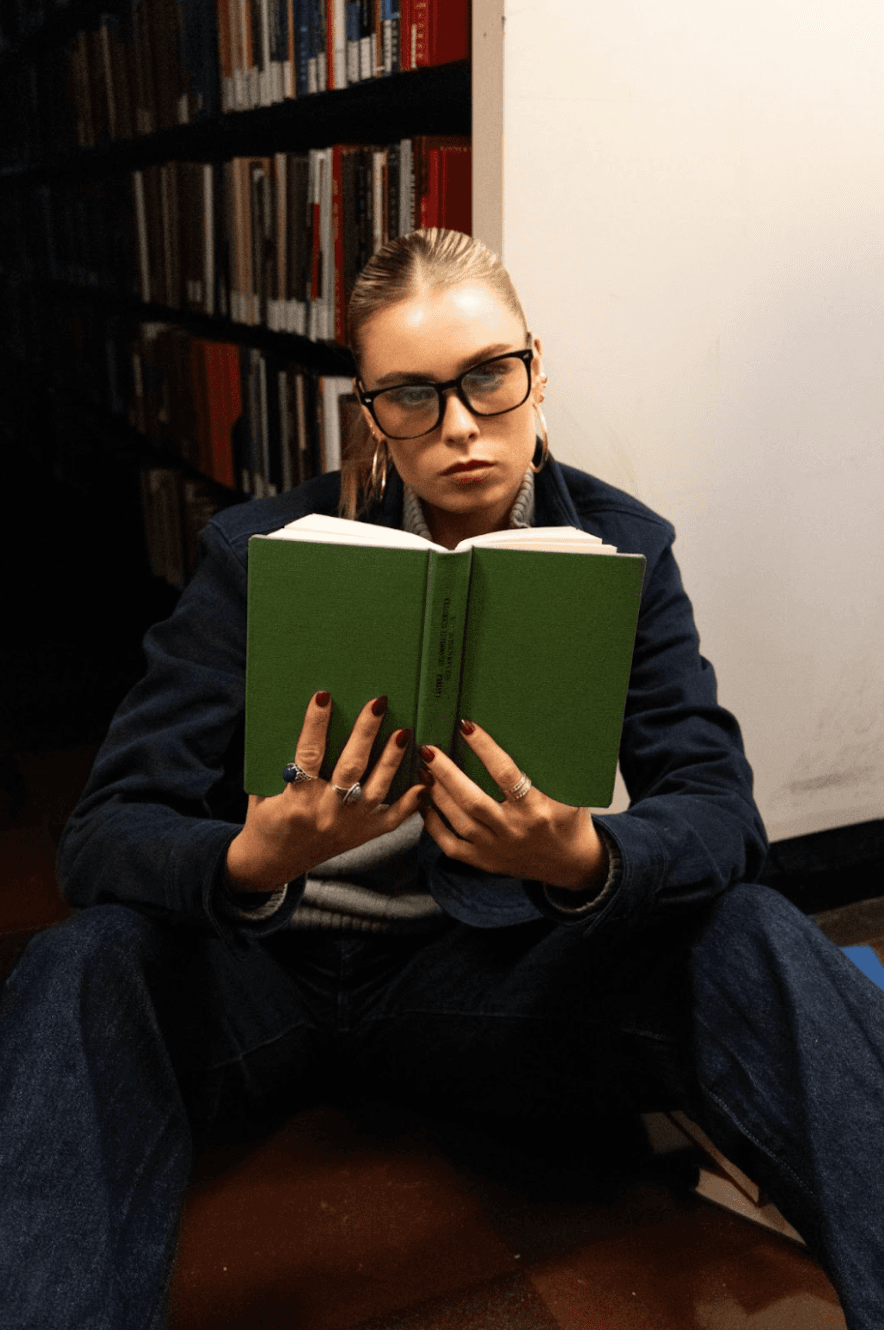
Another word which arose again and again in our conversations was "classy." When asked if there was such a thing as a "Columbia look," most of the interviewees struggled to come up with an answer. In more than a few conversations, the predominance of the broody, romantic, academic trench coat was mentioned. Some people commented on the Longchamp bag, the Frye boots everywhere, or even the ubiquitous Columbia sweatshirt, but a distinct Columbia style seemed out of reach. Perhaps there's not so much a look as a vibe, an aura. Columbia students, it seems, are dressing with a purpose. They live in New York City and are pursuing their education with things to do and places to be - they need to look good doing it! The freshmen are discovering that the fashion bar on campus is a bit higher, and are rising to meet it.
While this stylish atmosphere remains true, Tomás Sanabria has also observed a "Columbia theater," a way of dressing to look like you're busy or important ("It's Monday, and I go to Uris, and there's 20 guys in suits. And I'm like, 'what are you guys doing? It's 7:30am. Go to bed. Go to bed.'") to impress others. When it comes to fashion people actually admire, it seems like authenticity is the name of the game. The incoming freshmen are stepping into a fashion culture on campus having the freedom to explore their style, to give and take from their influences, without feeling like there is a hegemonic "look" to work around.
Many freshmen are also finding fashion inspiration in the unlikeliest of places. If you ask Veronica Hatch, the Carman elevators are New York's hottest fashion incubator. The almost laughably long waits for the one elevator (the other is broken) has forced her to spend long periods of time with other students, and has introduced her to "a lot of influences." The idea of finding inspiration in your peers is a novel and exciting experience for a lot of freshmen. Lamenting the long wait with strangers in the Carman elevators builds community, laying the foundation for the exchange of style inspiration. Similarly, according to Billy Quinn, there is no greater source of fashion inspiration than the NYC Subway. Coming from car-centric LA, he explains that you go from one place to another without ever seeing anyone you don't know. In New York, however, "you just see more people." More people, more influences, more inspiration, more ideas. Although not everyone's primary influences come from campus, two interviewees, Nigel Harris and Veronica Hatch, credit their parents with their sense of fashion. While Veronica has been inspired by her mother from day one, Nigel says that his appreciation for the way his father dresses has grown more in recent years. Dressing well can be a family affair.
For some freshmen, it feels like they are arriving on campus in the moment after the moment. There are no more encampments, the administration seems to have entered a relative stand-still with the federal government, and though the atmosphere on campus is still immensely tense, there is no action. The freshman narrative is being haunted by the ghosts of years past, by protests and protocols they were not here for. It seems that there is a freshman malaise, or as Billy Quinn described it, an "apathy," flowing as an undercurrent through the class of 2029. There is a strange, surreal absence coloring much of their experience. Many freshmen are looking downtown, perhaps to friends at Pace or NYU, or to the loci of cultural fermentation that are Washington Square Park or Saint Mark's to find a creative, expressive community. What does this mean for the fashionable, creative, or humanistic communities here, when they find their centers of gravity shifted away from campus?
Two students I spoke with are not just negotiating their relationship with NYC for the first time, but America as a whole. Coming from Cali, Colombia, Tomás Sanabria is battling it out against the NYC cold. For the first time ever, he is contending with what it means to find a "fall fashion." Being away from home, living not just in a different country but a different language, he acknowledges the waves of homesickness that come. Still, he is finding ways to carry his family with him, even in a new place. Tomás, already a sunny person, absolutely lights up as he explains that his grandmother has knitted him scarves every year since he was a baby, but in tropical Colombia, he had nowhere to wear them. Now, in New York, he finally has the right climate to show them off: "When people say, 'I love your scarf.' I'm like, 'Oh, my grandma made this.'" While adopting the signature Columbia layers and growing into a new cold-weather style, Tomás is making sure to keep his family close to his heart (literally!). Likewise, Fernando Sanchez, from Mexico City, Mexico, has a similar pride in wearing his culture. Speaking about a special, specific article of clothing, Fernando explained how his 100% wool, hand-woven poncho from a local artisan is both an inspiring and grounding piece of clothing for him. Smiling wide, Fernando explained that "It was woven by someone, and I bought them directly from them. Every time someone asks me, 'Where did you buy that?' I'm like, 'This is not by a brand. This was made by someone lovingly.'" While embracing NYC and the campus community, Fernando makes sure to show off his local pride.
Regardless of where they come from, whether they are lifelong New Yorkers or newly minted residents, everyone has to get dressed in the morning. So, what's going through their heads when they pick out an outfit for the day? Gisela Lau says that, as a dancer, she's opting for pieces of clothing that she can move in. Tomás Sanabria seconds this point, explaining that on days he has dance classes, it's all about function. Nigel Harris says that his style really does depend on the day. In a dream world, he would be able to dress slightly preppy one day, and then emulate Playboi Carti's look from the Fall 2019 Off-White fashion show the next. Veronica Hatch laughs and divulges a study hack she has developed since being on campus: wearing her most uncomfortable jeans to Butler or Avery and not allowing herself to change until she gets through her work. Her fashion choices are most influenced by her childhood downtown, with hours spent in beloved independent coffee shops, and by her mother. Billy Quinn is dressing for the weather. Born in London but raised in LA, he's finding the confluence between these identities here in New York City. Fernando Sanchez finds himself in more and more sweaters - especially in yellow, because they remind him of marigolds.
It feels only right to give the first years the last word in this article, so to close things out, here is how the class of 2029 describes their fashion in their own words.
Veronica Hatch: "Dire Straits, Rachel Harrison, Lost in Translation"
Nigel Harris: "Chill but expressive"
Gisela Lau: "Athleisure, evolving, comfortable, on-the-go"
Billy Quinn: "Jeans, boots, jackets, ?"
Tomás Sanabria: "Preppy, comfy, layered, queer, accessorizing"
Fernando Sanchez: "Teenager, Fall, coming of age movie"
Emma Donnelly: "Trendy, explorative, simple, street style"
Sterling Waterfield: "Everyday minimalism with flair"