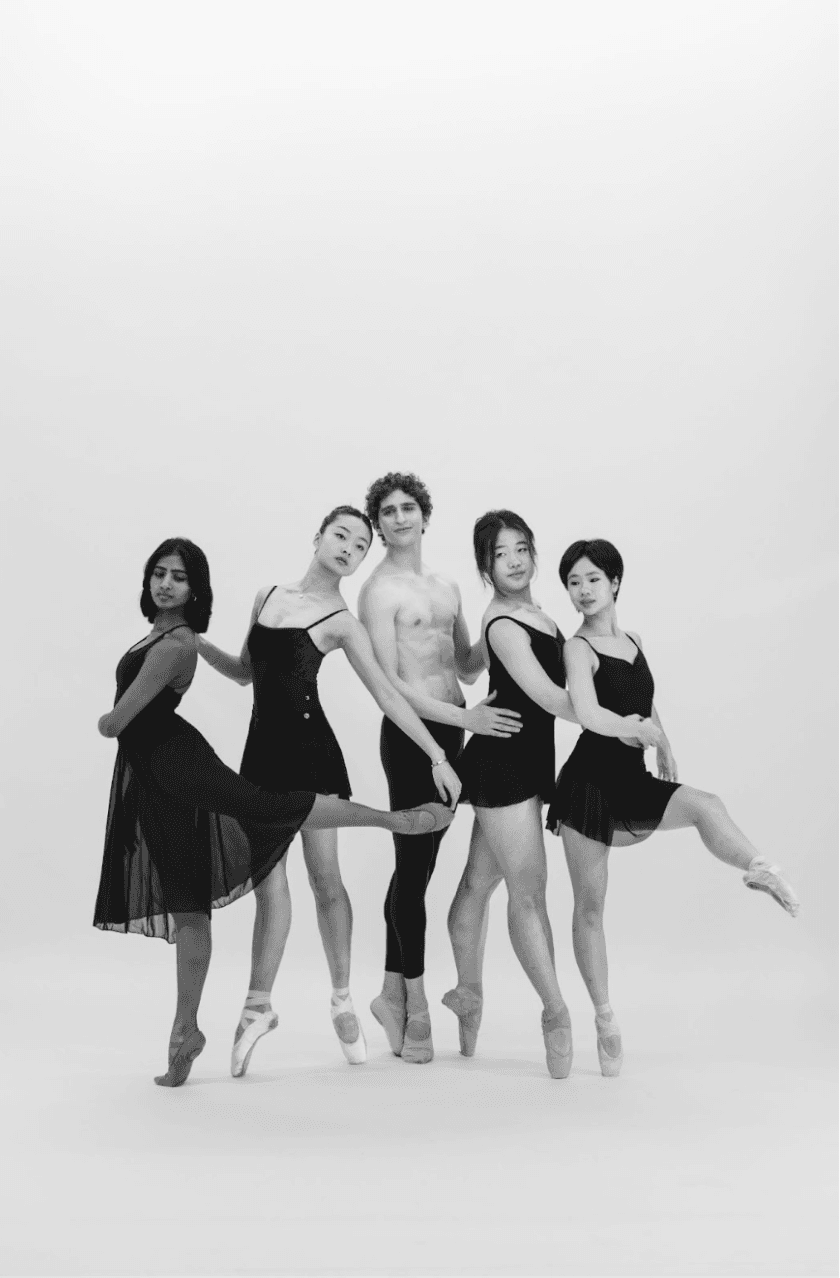
Columbia Ballet Collaborative dancers explore their relationship with clothing as an extension and vehicle for their dance; while discussing the complicated narratives that balletcore has pushed onto their artform. We discuss the distinction between what differentiates the aesthetic from the true grit of the studio.
Ballet flats carefully sidestep puddles on College Walk. Soft pinks, leg warmers, and gentle bows feminize athleisure. Cardigans cross, wrap, and tie in front. The aesthetics of ballet have wandered off the stage and into our modern feminine closet. But today's "balletcore" is just the latest iteration of a long conversation between fashion and ballet, where the world of fashion reaches for the visual persona of the 500-year-old classical dance form and reduces it to an independent aesthetic.
The label "balletcore" is used to describe day-to-day wear inspired by the aesthetics of ballet. While the term "balletcore" is a recent addition, according to Laird Borrelli-Persson's retrospective published in Vogue, the relationship between fashion and ballet dates back to the early 20th century. The costuming of ballet itself has drastically evolved over the past 500 years: costumes have become lighter to better display the dancer's footwork, and the pointe shoe has taken the place of the heeled shoe to increase the impression that the dancer was weightless. In the 1930s and 40s, the gentle elegance of tulle and ballet slippers was first integrated into evening wear. Now, ballet-inspired fashion goes beyond the costumes dancers wear on stage, taking inspiration from rehearsal wear and the imagined "off-duty" look.
There is something alluring in the cultural symbol of the ballerina, who lives up to a historical societal standard of white, heteronormative beauty. We open up a music box, and the toy factory's ballerina spins to a familiar tune. This ballerina has complete control, she is strong, the dance she performs is moving. The boxed ballerina is the image of ballet from which "balletcore" is drawn, oversimplifying a complex and evolving artistic community. Admiring the ballerina is often more of a reflection of what we value, rather than the reality of the medium.
Even so, ballet is an art that emphasizes the body as an aesthetic. While explaining the rhetoric around the physical body in professional ballet spaces, Henry Lichtmacher—CBC dancer and emerging choreographer—is caught between the rhetoric he has heard as a ballet student and professional, and the realities of the dance world.
"As much as they can say, talent is the most important thing, as long as you are talented and passionate, you can make it anywhere, a lot of it is just empty words," said Lichtmacher. "Truthfully, if you don't meet a certain body standard, it's hard to get a job, period, and obviously, I think that's the problem."
Perhaps, this complicated relationship to aesthetics is why, after a lifetime of commitment to this physically intensive art form, ballet dancers are bemused when I ask them about a reductive "balletcore." Many of the Columbia University dancers that I spoke with came to college from youths spent attending ballet academies, summer programs, and even dancing with professional companies. Professional dancers seeking both academic rigor and immersion in New York City's artistic hub have long been drawn to Columbia University, often setting aside full-time performance careers for their academic pursuits. Their presence has helped fuel the university's acclaimed student dance organizations, including Columbia Ballet Collaborative (CBC), which benefits directly from the artistry and discipline these dancers bring with them.
JiaLi Deck, a sociology major at Barnard College and the Assistant Public Relations Director for CBC, noticed the uncomfortable juncture between ballet and the fashion it inspired. At first, she was drawn to ballet-inspired items hitting major brands like Urban Outfitters, but Deck quickly became disgruntled with the trend as a devaluation of the serious nature of ballet.
"Ballet isn't just an aesthetic," Deck asserts."It's not just a visual motif. It's this actual, really robust sport, art, practice. They don't do that to men's sports."
She found the trendy Steve Madden's ballet heels, which include satin ties around the ankle, frustrating. These shoes—inspired by the visual value of ballet—ignore the practical nature of pointe shoes, which dancers earn through rigorous training, and have been honed over hundreds of years to support the dancer.
Deck has a number of hypotheses for the resurgence of stereotypical ballet as a source of fashion inspiration. She notes that many women briefly encountered ballet as children. Donning ballet-inspired pieces may spark memories of watching oneself in an elegant pink leotard, tights, bun, in the mirror of a local dance studio. Deck also acknowledges that for many viewers, ballet is an escape from reality. For Deck, ballet is not independent from current issues and is still grappling with evolving ideas of femininity, on and off stage. And when the dancer exits the stage, they have real challenges to face.
"You escape from the real world by watching ballet," JiaLi said. "The ballerina is still living in the real world, and she still has bills to pay, and she still faces racism, and she still faces the effects of all of these social, political forces that you may be escaping when you're watching her dance."
While "off-duty model" and "off-duty dancer" aesthetics are increasingly commonplace, it is impossible to make one conclusive statement about how ballerinas dance outside of the studio. When I asked CBC dancers about their personal fashion, they hesitated, but they often brought up comfortability, affordability, color, and the stories behind specific items they have bought while traversing the world to perform and train.
Attempts to refine the complex universe of ballet into a collection of hyper-feminine, tulle-forward pieces will always come up inauthentic. Ballet is also an art form on the move. And like all commercial art forms, its direction is shaped by its audience and its times. CBC is an embodiment of the ways in which ballet is not stagnant, by focusing on new works choreographed by emerging choreographers.
While street fashion emulates the ballerina, ballet is concerned with its portrayal of reality. When Henry Lichtmacher was 10 years old, he was cast as a rooster in Christopher Wheeldon's Carnival of the Animals. When his teacher proposed his rooster costume, including large feathered pants, he said he already had an understanding of the difference between theatrical and ballet costuming.
"I remember, even at 10 years old, voicing my concerns, I just didn't feel like it matched the overall vibes that we were trying to give off, or like the aesthetic we were trying to show," said Lichtmacher. "And I remember he listened to my comments, and they ended up editing the costume."
When I speak with CBC dancers about the meaning of costuming as dancers, they are apt to bring up moments that embody their development as people. Christine Li reveled in finding individuality in a new leotard that fit the constraints of her school's dress code. Deck remembers the reactions of her family members to costumes she wore during shows. Sreya Sathish Kumar reminisces on choosing costumes that matched her skin tone and made her feel confident on stage.
Lichtmacher now designs his own costumes as a choreographer for CBC, working within the club's limited budget to find pieces that allow the dancers to have individuality within the community of a finished piece.
Lichtmacher explained that in ballet, form-fitting costuming is important to preserve the lines created by the dancer's bodies. With the freedom of 21st-century modesty standards, this results in minimal costuming.
"A lot of contemporary costumes nowadays are practically naked," he said. "It's very rare to see a fully clothed dancer nowadays in the piece."
So while the ballet world becomes more inclusive and sustainable for its dancers, balletcore retreats to the ballerina in the music box. When fashion borrows from ballet, it rarely borrows the labor, the discipline, or the contradictions that define the art form. Instead, it selects softness without strain, elegance without effort, femininity without cost. What we choose to wear when we dress "like" ballerinas reveals less about ballet and more about our own ideals. Beyond the Pinterest boards and satin ties lies an art built on motion, discipline, and evolution.