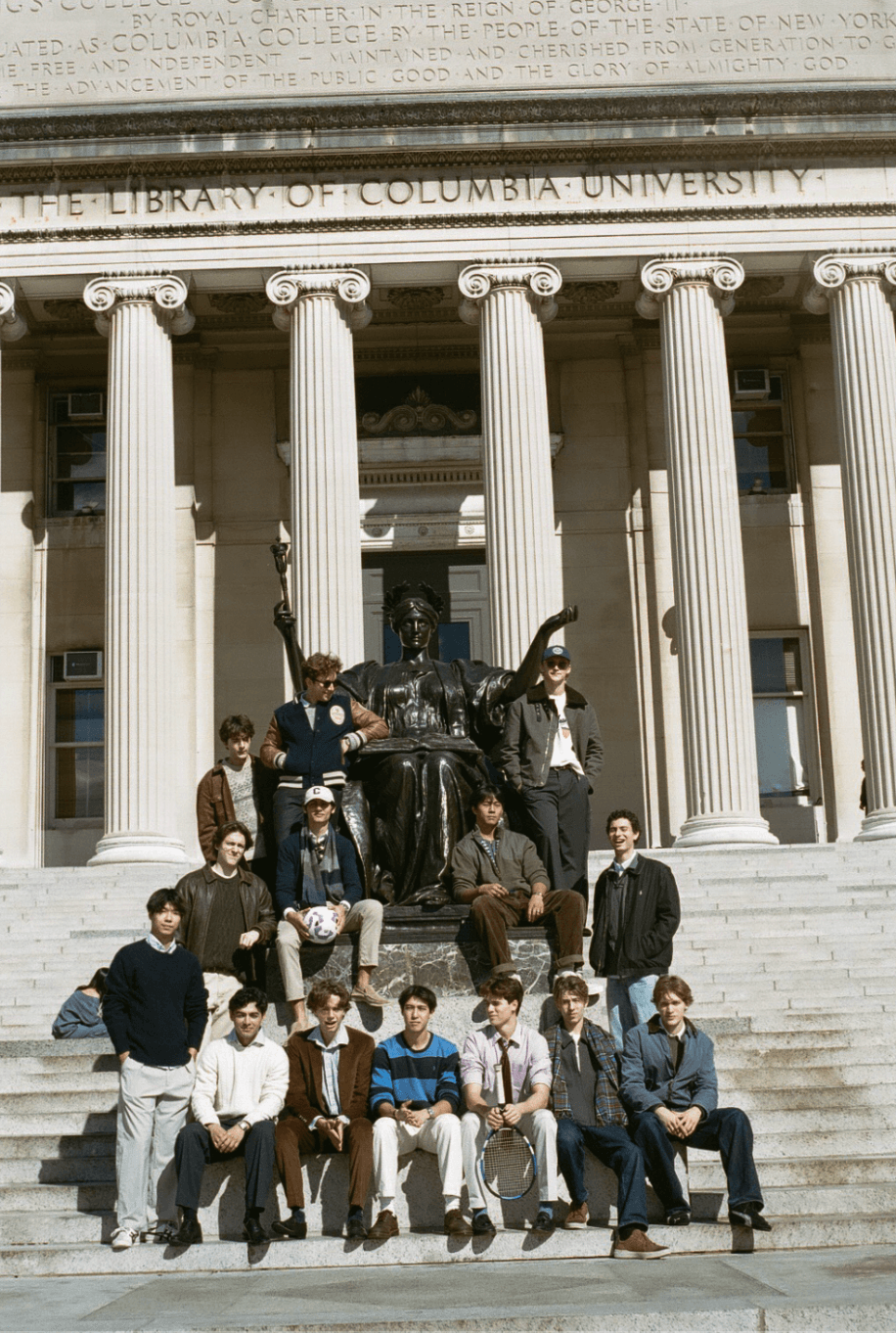
The sun hits Columbia's campus as brown corduroy pants, shining penny loafers, and pristine wool sweaters meld with the fall foliage. A group of members of the Sigma Phi Epsilon fraternity populate the lawn, tossing a football and sharing jokes while the camera clicks. Their uniform style–classic, preppy, collegiate–signals their brotherhood as much as their camaraderie. Though lightly posed and carefully dressed, the scene still feels natural, a glimpse of what an onlooker might see on any warm, October day at Columbia University.
Sigma Phi Epsilon–or Sig Ep, as it's more commonly known–has only had a chapter on Columbia's campus since 1996. Though relatively less established than Greek life institutions at other universities, the Sig Ep community is a strong presence in Columbia's campus culture.
Many of Sig Ep's current members–or brothers–did not envision joining a fraternity when they first came to college. "I was against Greek life. I thought it was corny," said Warren Axelman (CC '28). "Then, I came to Columbia and I realized that it's not the same here as it is in a lot of the southern universities or big state schools." Wright Chen (CC '28) had a similar outlook, saying, "In high school, I had a very horrible impression of Greek life. I swore to myself I would never rush a frat." All brothers cited the difference in Columbia's fraternity environment compared to the stereotypical Greek life experiences they envisioned, with Sig Ep standing out to them in particular.
Fraternities are social institutions marked by exclusivity and tradition. They emerged in the nineteenth century, representing an intersection of the eating clubs, literary societies, and secret societies that permeated collegiate life in years prior. Though starting off in secret, fraternities quickly became intertwined with the practices of the university, partnered in preparing men to join upper levels of society.
Dress visually demonstrated these values, with tailored suits, oxfords, and crested insignia promoting the elite, gentlemanly outlook these institutions sought to foster. In Ivies like Princeton, Yale, and Harvard, fraternity brothers pioneered a casual, stylish fashion that would later become associated with the conservatism of Eastern establishments of the 1950s, and the notion of "preppy" in the 1980s.
As years went on, these types of associations continued, with brothers encouraged to dress in a similar gentlemanly, preppy style to signal their exclusivity and values. For instance, in 2013, an email by an Alpha Tau Omega member at Emory University went viral for pushing his brothers to be more well-dressed: "Look sharp and keep the bank unbroken by putting on this J Crew Ludlow Suit."
The tension between the classic, exclusive, and character-building organization and the conduct of its members defines modern Greek life. The contemporary perception of fraternities is dominated by narratives of extreme hazing, sexual assault, and reckless behavior, an image shaped by decades of scandals and national media coverage. This is reflected in the newer association of dress that characterizes fraternity culture– shorts, jeans and t-shirts, with a backwards cap on head and a Bud Light in hand. The term "frat" carries a new association, evoking a more unsavory side of these institutions.
Columbia is not immune to this. Just last year, Beta was kicked off campus after their group chat of racist and sexist comments was exposed. Beyond that, while technically open to all men, there remains an association (and general practice) of frats predominately consisting of white, heterosexual males. There is a purpose for this exclusivity; gaining acceptance to these frats opens supportive doors that remain beyond graduation. Fraternities have grown to serve as steady pipelines into elite professional and political networks. At Columbia, this ranges from career networking through alumni associations to prime housing access in owned brownstones.
Columbia's Sig Ep exists as a local example of this broader contradiction: an institution that inherits the aesthetics, networks, and exclusivity of fraternity tradition while operating within a contemporary campus culture. Dress remains key in signaling this duplicity as well as brotherhood connection.
Many brothers attributed being in a fraternity as an important influence on their stylistic growth during college, whether it be buying specific items or changing how they approached fashion. In the words of Jack Rudd (CC '27), "Being close to people who are well dressed sort of pushes you to live up to the name." Brothers putting effort into their appearance, putting effort into being well dressed, signals not only a personal investment but also, in this community, nods to a group unification.
Linen suits, boots, Henleys, vintage sweaters, loafers, and even winter scarves were cited as items that brothers added to their closets since joining the fraternity. "I got a trench coat just because I saw all my brothers looking so dapper," said Logan Lambert (CC '27). This inspiration is felt across the community. Chen emphasized, "When I go to a store or thrift shop I ask 'Would Logan, would River wear this?' And if the answer is yes, then I'm buying."
"I would say that Sig Ep is remarkably well-dressed," said Will Owen (CC '27). The men at the shoot, all in garments taken from their own wardrobes, embodied the historical, traditional notion of fraternity: elegant, collegiate, preppy style. From the wool sweaters to the literal tennis racket, the men looked like they stepped out of a J.Crew catalogue.
Some of the brothers asserted that this snapshot is accurate of how many of them dress on a day-to-day basis. Schwarz noted, "The guys do dress like this in their own free time. When we're not partying and wearing our frat T-shirts, this would probably be how we're dressed." Indeed, it was interesting to see this pristine, traditionally Ivy aesthetic after the contemporary "fratty" ensembles that populated the frat's Homecoming party just days prior: backwards baseball caps, jeans, sneakers, and special edition Sig Ep t-shirts, and, of course, Bud Lights in hand. Brothers dress to the textbook Ivy standard for their classes and don casual, frat garb for their weekend parties.
This speaks as much to the character of the brothers as much as it does to the privileges an institution like Sig Ep allows them. From major influence in the Greek life community to the networking opportunities and connections they gain access to, Sig Ep brothers are a part of a supportive environment that extends beyond pure brotherhood. "I definitely get this feeling of being a part of an institution that is supporting my way through Columbia," said Owen.
Many brothers were adamant to express the differences in style that they felt were emblematic of their community. Rudd stated, "There are a lot of people in Sig Ep who dress very, very differently. That amalgam is what we're all sort of getting at with how well-dressed it is. There is no one archetype at all." In other words, it seems that what distinguishes the Sig Ep style is not a question of what is worn, but rather how it is worn. Not all chose to slip on a pair of loafers and a trench coat when dressing for their day, but whatever they choose is chosen with intent.
Differences in dress come with these different backgrounds that make up the Sig Ep brotherhood. Chen spoke on some of the subcultures found within the fraternity. "We have the finance bros, the British guys, guys from the city, and some rugby players." The fraternity's style is thus more of a collage of elements rather than a codified uniform, a layering of influences and aesthetics that coexist under one name. As Chen put it, "There's not one archetype. Everybody has very interesting different backgrounds." This leads to various types of stylistic inspiration. River Cornwell (CC '28) reflected on this fusion in his own style: "I have this weird mix of the Los Angeles skating look with my newfound preppiness from the international community."
While there is no archetypal Sig Ep brother in terms of his dress, what seems to set him apart is the effort he takes to dress well, no matter the garments. Seeing the group together dressed very similarly, whether on the lawns or at a Homecoming party, makes it difficult to feel the same differences the brothers articulated. The crisp, clean, uniform collegiate style communicates the idyllic vision of the Ivy fraternity: timeless, composed, and exclusive. The men in Sig Ep are unified and partly defined by this collective identity. Simultaneously leaning into their differences and engaging in the stereotypical fraternity aesthetic is emblematic not only of the garments the brothers wear but also of how their institution fits into the Columbia community and the broader conception of Greek life.