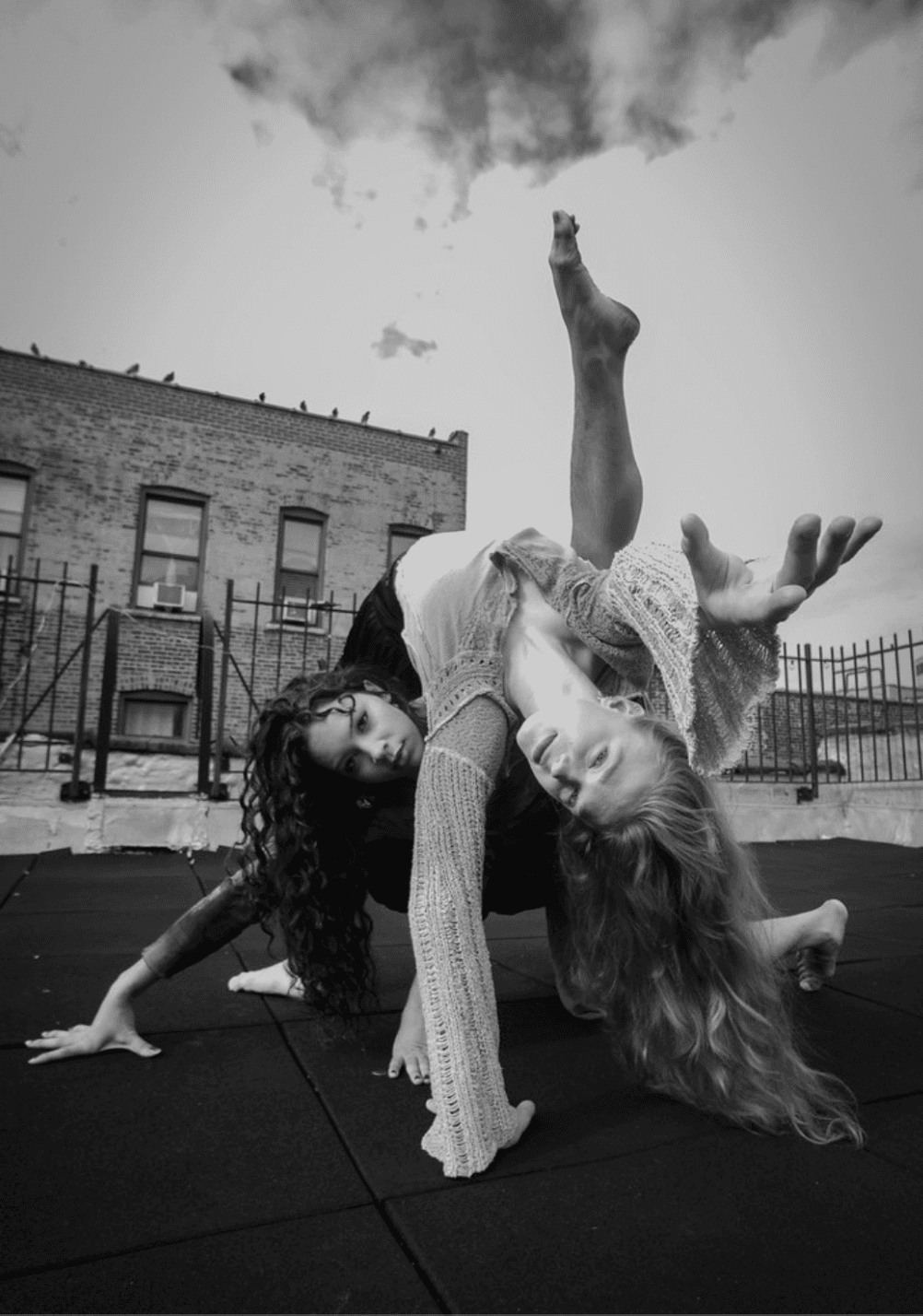
"I like feeling like I'm free," mused Genevieve Redmond, leaning against the siding of the open-air roof. While classically trained, Redmond's clothing choices in rehearsal are the antithesis of the typical rigidity of balletic costumes. If she does wear tights, she avoids the classic leotard and pink tights — instead opting for black tights and cutoffs. She prefers costumes that don't feel like she is wearing them, so that she can focus on her art and the movements of her body. The tradition of ballet requires that its dancers adhere to a strict set of costuming and movement rules, which in turn define the critical strength of the dancer and their performance. Modern dance is the opposite: free; the body is the dancer's critical guide, and costumes need to encourage its movement.
Modern dance initially emerged as a protest against rigidity in genres like ballet. At the fin de siècle, dancers began to question the norms that had long characterized dance, and traded unforgiving regulation for experimentation. Thus, modern dance developed throughout the following century, an artistic amalgamation of genres, techniques, and methodologies, united by a philosophy that prioritized movement as an interpretative tool. Several luminaries commanded this progression; one of the earliest was Loie Fuller.
Loie Fuller's popularity came from her use of costuming to augment human movement. Born in America, Fuller only reached commercial success once she emigrated to Paris. Her revolutionary dance, The Serpentine, which enraptured the French metropolis, was distinguished not by her bodily movements, but by the massive dress she wore, a mammoth of drapery and folds. In her performance, she manipulated the vast, streaming fabric — whirling it around her — and filling the stage. Fuller's performance proved that clothing could be used to evocatively extend the reach of the dancer; fabric and its movement could assume an artistic quality.
Loie Fuller's free-flowing ideas have remained a significant part of modern dance today. On the roof, I also spoke with Maggie Lynch, another member of CoLab, a performing arts collective at Columbia. It was a week before Lynch's department show, which would mark the first time she wore a long dress in a dance piece. "I think there's a lot of space there for added movement," Lynch remarked, "which wouldn't be there without the fabric." Like Fuller's Serpentine, a fabric-laden dress would not be a restrictive piece, but instead act as an extension of the dancer—a tool through which they could extend their body's rhythmic movements.
Soon after Loie Fuller came Isadora Duncan, another trailblazer of modern dance, who envisioned a form of dance that celebrated the human body's natural movement, rather than traditional methods of dance that perversely contorted and reconfigured it. Duncan's style of dance was more anatomically intuitive and gentle on the body than ballet. She was known for dancing barefoot, often in tunics reminiscent of ancient Greece, simultaneously demonstrating a reverence for and rejection of past artistic traditions. Isadora Duncan marked a newfound respect for the body's innate inclinations: humanity as art.
Marisol Ramirez-Buckles, one of CoLab's choreographers, is similarly inspired by using a dancer's natural movements and strengths to create pieces. She often employs improvisation, which relies on a dancer's natural inclinations and musical interpretation to construct a coherent sequence. Like many modern dancers, Ramirez-Buckles maintains a measure of training in a more restrictive genre; she grew up dancing folklórico, a genre of Mexican folk dance: "It's rigid in the way ballet is rigid." A background in a more limiting genre provided Ramirez-Buckles with a deeper understanding of detailed movement replication, which she employs in her choreography practice and personal dancing. Similar to Duncan's tunics, Ramirez-Buckles prefers dancing in something flowy, which lets her focus on her body's movement.
After Isadora Duncan came one of the most recognized figures in modern dance: Martha Graham. Graham sought to include narrative in modern dance performances, creating a genre that did not only focus on individual movement, but also storytelling. Emotion became a more crucial element of performance, to register fictive plot points within a dance. Graham moved beyond Duncan's natural movements, and sought to create bodily tension, by exaggerating these movements. Graham perfected the techniques of modern dance as we understand them today, allowing for its development into a fashionable and respected genre.
Genevieve Redmond, Maggie Lynch, and Marisol Ramirez-Buckles are all inheritors of a modern dance tradition that prizes freedom, individuality, and storytelling. Through my interviews, I learned that the philosophy of modern dance inhabits almost all aspects of their lives; all three dancers emphasized the importance of streetwear that allows them to transition easily into their rehearsal outfits. Layers allow dancers to transition seamlessly from lectures to studios, and loose clothing permits dancers to focus primarily on their craft. The philosophy of modern dance permeates each dancer's costuming choices and personal style, creating a style that is simultaneously performance-ready and class-worthy.
Sources
- https://www.kennedy-center.org/education/resources-for-educators/classroom-resources/media-and-interactives/media/dance/dancing-to-different-rules/
- https://nmwa.org/blog/artist-spotlight/isadora-duncan-a-revolutionary-dancer/
- https://www.scfta.org/discover-watch-listen/articles/_/the-legacy-of-martha-graham